
There’s a moment that repeats itself hundreds of times a night in every venue that serves drinks. Someone sets down a cup. It’s half full. There’s ice in it, a straw, maybe a wedge of lime. And there’s nowhere good to put it.
That moment is the whole problem. Everything else comes downstream of it.
Most operators don’t think of beverage waste as a category worth managing. It’s just mess, and mess is part of the job. But the handling of half-finished drinks quietly sets the pace of your service, the state of your drains, and how long your team stays after the doors close.
The short version
- Beverage waste costs you in four places: trips away from the station, blocked drains, failed bags and wet floors, and a closing shift that runs long.
- A sink solves it only when the sink is close. Most event, hotel, stadium and mobile service happens away from plumbing.
- Separating solids from liquid at the point of collection is what removes the walk.
- Watch one service for three things: who leaves their station carrying liquid, how slowly the drains clear, and where the floor gets wet.
Where beverage waste actually costs you
Trips away from the station
Every drink that can’t be emptied where it’s collected becomes a walk. Your bartender carries a rack of glassware to the sink. A banquet server crosses a ballroom with a bus tub sloshing at the rim. A concessions attendant leaves the counter during a rush.
None of those trips is long. That’s exactly why nobody counts them. They just accumulate, and they always happen at the moment you can least afford them, which is when it’s busy.
Your drains
Sink drains were built for water. What actually goes down them in a service environment is ice, citrus wedges, straws, cherry stems, coffee grounds and cocktail garnish. Ice melts and passes. Everything else settles.
The cost here is invisible until it isn’t. Slow drains become standing water, standing water becomes a call to a plumber, and that call always seems to land on a night you’re fully booked.
Bags and floors
Liquid poured into a lined bin is a bag that’s going to fail. It fails on the walk to the dumpster, and it fails across a floor your team then has to mop. Somebody has to double-bag, somebody has to carry it, and somebody eventually slips.
A wet floor in a service area is a safety issue before it’s a cleaning issue.
The closing shift
Closing is where all of it lands at once. Every cup that wasn’t dealt with during service is waiting at the end of the night. Staff are tired, they’re on the clock, and the last hour is spent emptying, walking and mopping instead of resetting the room.
If your closing time has crept later and nobody can point to why, look at what your team is carrying and how far.
Why “we already have a sink” doesn’t settle it
If your sink is a step away from where drinks come back, it works well. Plenty of bars are built that way and don’t need to think about this at all.
The trouble is how much service happens away from plumbing. A hotel runs coffee breaks on a conference floor with no drain on it. A caterer works a wedding in a field. A stadium moves thousands of cups on a concourse where the nearest sink is behind a locked door. Food trucks, festivals, poolside bars, school cafeterias, church halls and office breakrooms all have the same gap.
In those rooms the sink isn’t a solution, because there isn’t one. The waste still has to go somewhere, so it goes into a lined bin, and you inherit every problem above.
What separation actually changes
A beverage waste station handles the two halves of the problem separately, because they’re genuinely different materials.
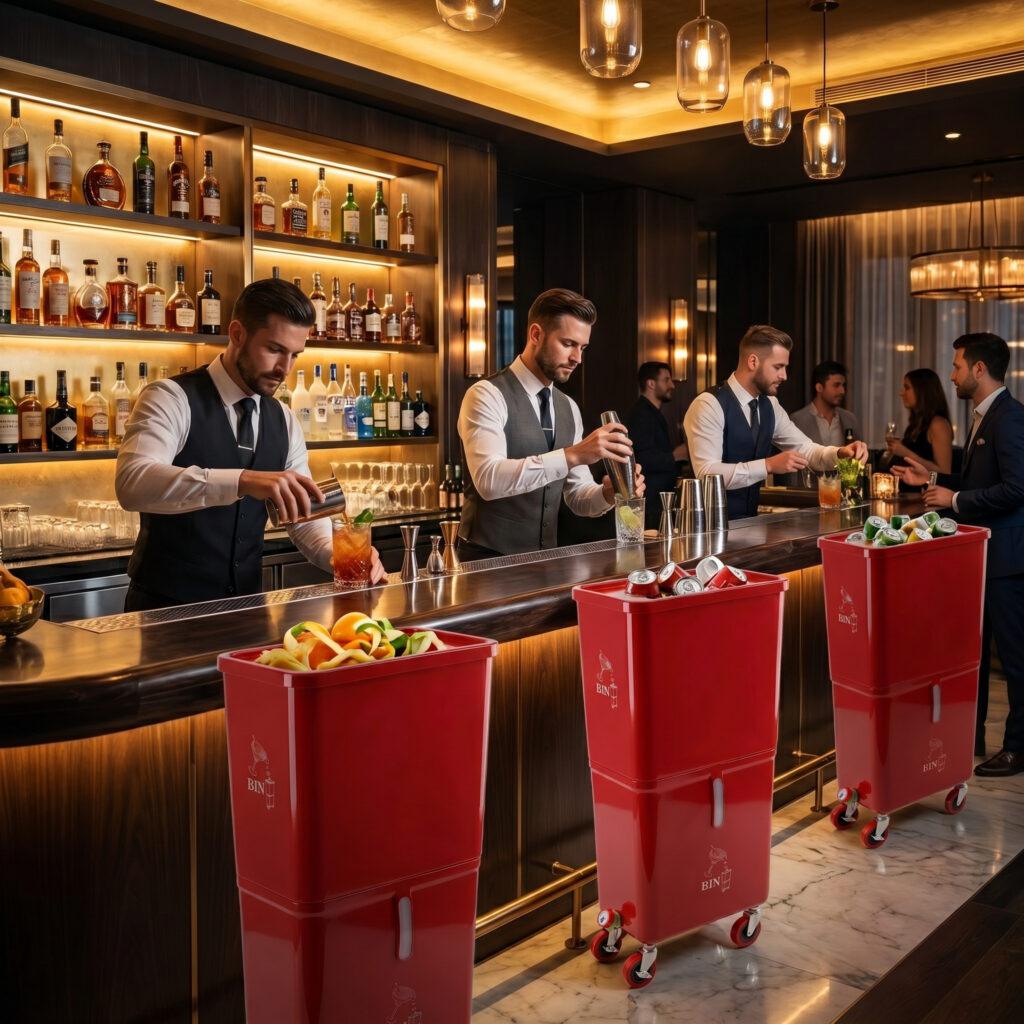
Solids stay up top. Ice, straws, garnish, napkins, cups and cans sit in the upper compartment. Liquid passes through a perforated HDPE separator into a lower reservoir that holds up to 21 gallons.
That split is what removes the walk. The mess gets dealt with where it happens rather than being carried somewhere else first.
Emptying works the same way. The Beverage Bin has a drain plug at the base of the narrow end. You roll it to a drain, twist the plug, and gravity does the rest. Nobody lifts a full container, because you never need to. Four swivel casters make it mobile and two of them lock when you want it to stay put.
There’s a transparent Liquid Level Reader on the front face so you can see where the reservoir stands before it becomes a problem mid-service. Knowing when to drain is most of the battle.
Sizing it for the room
A single unit stands 36 inches tall, which is roughly waist height, on a footprint of about 14 to 16 inches wide by 8 to 10 inches deep. It’s a tall, slim shape rather than a wide tub, so it fits at the end of a bar, beside a service station, or against a wall on a banquet floor without eating into working space.
Empty, it’s 15 lbs. The body is heavy-duty industrial-grade HDPE, chosen for impact resistance and a finish that cleans up without holding onto anything.
Cleaning is deliberately simple. Open the plug, rinse both compartments, lift the lid right off if you need to get at it properly. There are no filters anywhere in it, so there’s nothing to trap residue and nothing extra to service.
It comes in Black, Blue, Red, Green and Yellow, so it can either disappear into a back-of-house area or read clearly as a station in a public space where guests will use it themselves.
Where to start in your own operation
Before buying anything, spend one service watching for three things.
Count how many times someone leaves their station carrying liquid. Look at how long your drains take to clear at the end of the night. And note where the floor gets wet, because that spot is telling you exactly where a station is missing.
Those three observations will tell you more about your beverage waste than any spec sheet, including this one. If the answers are all small, you’re fine as you are. If any of them made you wince, you’ve found where the time is going.
Common questions
What counts as beverage waste?
Anything left in a cup or glass when it comes back, plus everything mixed into it. Liquid, ice, straws, garnish, fruit, stirrers and the cup. It behaves differently from dry waste because the liquid separates and travels.
Can’t we just pour drinks into the trash?
You can, and most rooms do. Liquid in a lined bin soaks the bag, adds weight, and finds the floor somewhere between the bin and the dumpster. It also makes the bin heaviest at exactly the moment someone has to move it.
How much liquid does a station need to hold?
The lower reservoir on a Beverage Bin takes up to 21 gallons. What matters more than the number is being able to see where it stands, which is what the Liquid Level Reader on the front face is for.
How do you empty it without lifting it?
You don’t lift it. Roll it to a drain on the casters, twist the drain plug at the base of the narrow end, and it empties where it stands.
Where should it go in a room?
Wherever drinks come back. Behind a bar that’s usually the service end. On a banquet floor it’s near the door servers actually use. In a public space it can work as a station guests use themselves, which is part of why it comes in five colours.
Does this apply outside bars?
That’s where it does the most work. Anywhere drinks are served without a sink in reach: catering, festivals, food trucks, conference floors, stadium concourses, school cafeterias, offices and church halls.
You can see the full range at beveragebins.com, and if you’re outfitting more than a few stations, the wholesale page is the place to start that conversation.
Guides for your setting
The same costs land differently depending on the room. These go into each one.