
Ask a manager why closing takes so long and you’ll usually get an answer about staffing. Ask the staff and you’ll get a more useful one. They’ll tell you about the part where everything that got put off during service arrives all at once.
Most of that backlog is liquid.
The short version
- Closing runs long because service deferred work, not because the close itself is slow.
- Half-finished drinks are the single biggest deferred item in a room that serves them.
- A station at the point of collection converts a closing task into a during-service one.
- Fix the order of operations before adding people to the shift.
Where the time actually goes
A close has a fixed part and a variable part. The fixed part is wiping down, restocking, counting, locking up. That doesn’t move much.
The variable part is everything service left behind. Racks of glassware still holding liquid. A bus tub someone parked because there was nowhere to empty it. Cups stacked on a back counter. Bins that are too heavy to move because somebody poured drinks into them.
None of that was a decision. Each one was a small deferral made during a rush, when the alternative was walking away from a queue of customers. Deferring was correct in the moment. The cost just lands later, all at once, on people who are already tired.
The order that works
The sequence matters more than the effort.
Liquid first, always. Anything holding liquid gets emptied before anything gets carried anywhere. A rack of glasses that’s been drained is light and stackable. The same rack full of melted ice and backwash is heavy, it drips across the floor you’re about to mop, and it has to be dealt with anyway before it goes anywhere near a dish machine.
Solids second. Ice, garnish, straws, napkins and cups go out as dry waste once the liquid is gone. Bags stay intact, which means one trip instead of a double-bagging exercise.
Floors last. Mopping before the liquid is out is how a close ends up being done twice.
Most rooms do these in roughly the reverse order, because the liquid step has no obvious home.
Giving the liquid step a home
This is the whole reason a dedicated station changes closing times. It moves the liquid step out of the close entirely and back into service, where it costs seconds instead of an hour.
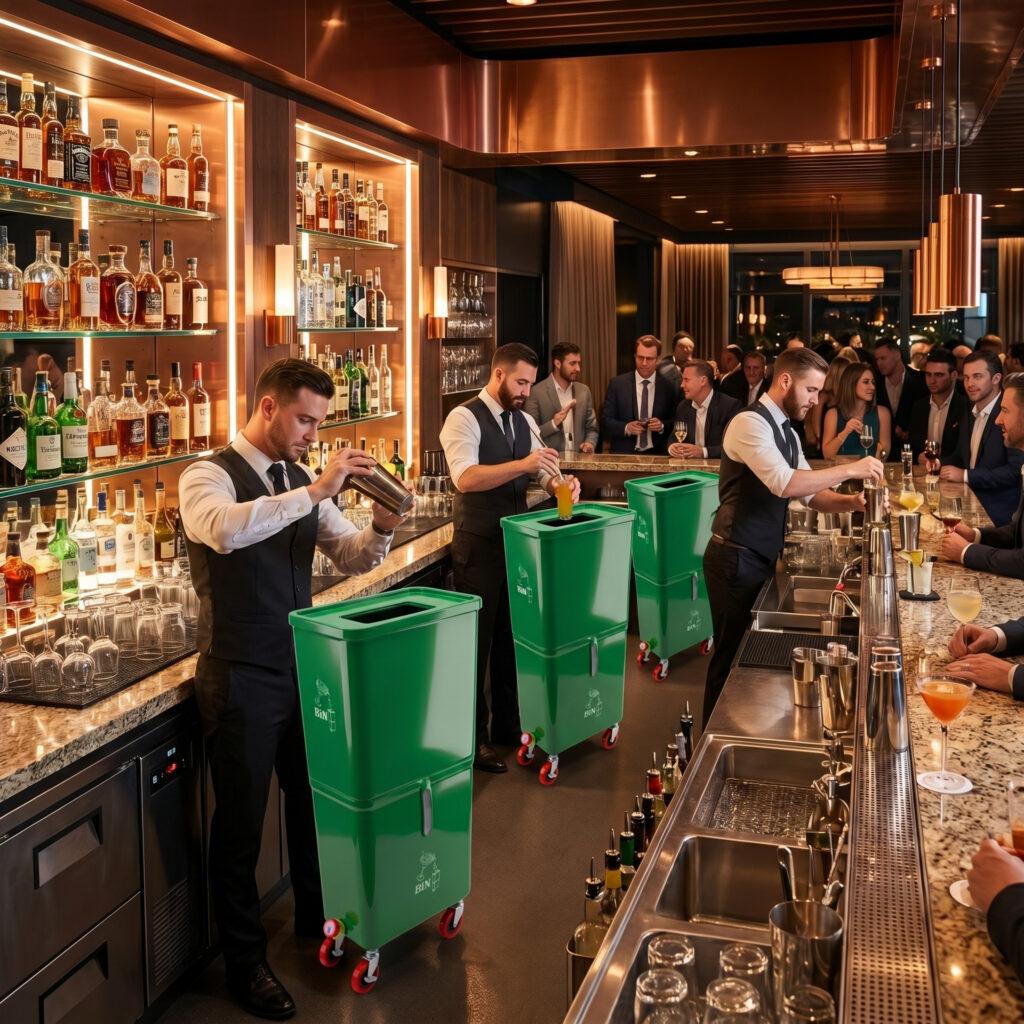
A Beverage Bin sits at the point of collection with two compartments. Solids stay on top. Liquid passes through a perforated HDPE separator into a lower reservoir that takes up to 21 gallons. Staff empty a glass in one movement without leaving their station.
At close, the station itself is the last thing handled. Roll it to a drain on its casters, twist the drain plug at the base of the narrow end, and it empties where it stands. Rinse both compartments, lift the lid off if it needs a proper clean. There are no filters in it, so there’s nothing to trap residue and nothing extra to service.
The transparent Liquid Level Reader on the front tells you whether it needs draining mid-service or whether it can wait for close. Knowing that in advance is what stops it becoming an emergency at the worst moment.
What to watch for over a week
Before changing anything, take one week and note three numbers on each shift.
What time the last customer left. What time the last person clocked out. And how many things were still holding liquid when service ended.
The gap between the first two is your real closing cost. The third number usually explains it. If the third number is high on your longest closes, you’ve found the lever, and it isn’t staffing.
Common questions
What is a drink dump station?
A container that takes finished and half-finished drinks at the point they come back, separating what’s liquid from what isn’t so each can be disposed of properly. The point is that it goes where the drinks are, rather than the drinks being carried to a sink.
Why does closing take so long even with enough staff?
Because closing inherits every task service deferred. Adding people to the close speeds up the fixed part and does very little to the backlog. Moving the liquid step into service is what shrinks it.
Can’t we just use a bus tub?
A bus tub holds everything together, which means someone carries the liquid somewhere else before anything else can happen. It also can’t be emptied without lifting it. That’s the step a drain plug removes.
How do you clean it at the end of the night?
Open the drain plug, let it empty, rinse both compartments. The lid lifts right off if you want to get at it properly. Smooth HDPE surfaces, and no filters anywhere in it.
Does it need emptying during service?
Depends on your volume. The Liquid Level Reader on the front face is there so you can see the answer rather than guess it, and drain on your own schedule instead of at the worst moment.
The full range is at beveragebins.com, and multi-station setups start at the wholesale page.
Guides for your setting
Closing looks different in each environment. These cover the specifics.