
If you’ve landed here because you saw one and weren’t sure what it was, here’s the plain answer. A beverage waste station is a container built for one job: taking finished and half-finished drinks at the moment they come back, and separating what’s liquid from what isn’t.
It isn’t a bin for rubbish. It isn’t a bucket. It’s a piece of service equipment, and it exists because drinks behave differently from every other kind of waste a venue produces.
The short version
- A beverage waste station separates liquid from solids at the point drinks come back.
- Solids stay in an upper compartment. Liquid drains to a lower reservoir.
- The reservoir empties through a drain plug, so nobody lifts a full container.
- It belongs wherever drinks are served and a sink isn’t within a step or two.
Why drinks need their own answer
Almost everything else a venue throws away is stable. Paper stays paper. Packaging stays packaging. You put it in a bag and the bag holds.
A returned drink is three materials pretending to be one. There’s liquid, which soaks through bags and finds floors. There’s ice, which is liquid on a delay. And there’s the solid part, the straws, garnish, fruit, stirrers and the cup itself.
Put all three in a lined bin and the liquid ruins the bag. Pour all three down a sink and the solids stay behind in the drain. Neither route works, which is why most venues end up doing a bit of both and mopping the difference.
How the separation works
A Beverage Bin has two stacked compartments divided by a fixed, perforated HDPE panel at mid height.
Drinks go in through an opening cut into the lid on the flat top. Solids stay above the separator. Liquid passes through into the lower reservoir, which holds up to 21 gallons once everything has drained down.
That’s the entire mechanism. There’s nothing to empty separately, nothing to rinse out on its own, and no filters anywhere in it.
Emptying is the other half. There’s a drain plug at the base of the narrow end face. You roll the unit to a drain on its four swivel casters, twist the plug, and gravity does the rest. Two of the casters lock so it stays put during service. Nobody ever lifts it full, because there’s no reason to.
A transparent Liquid Level Reader sits on the wide front face just below the seam, so the level is something you can check rather than guess.
Where it belongs
The rule is simple. It goes wherever drinks come back and a sink isn’t within a step or two.
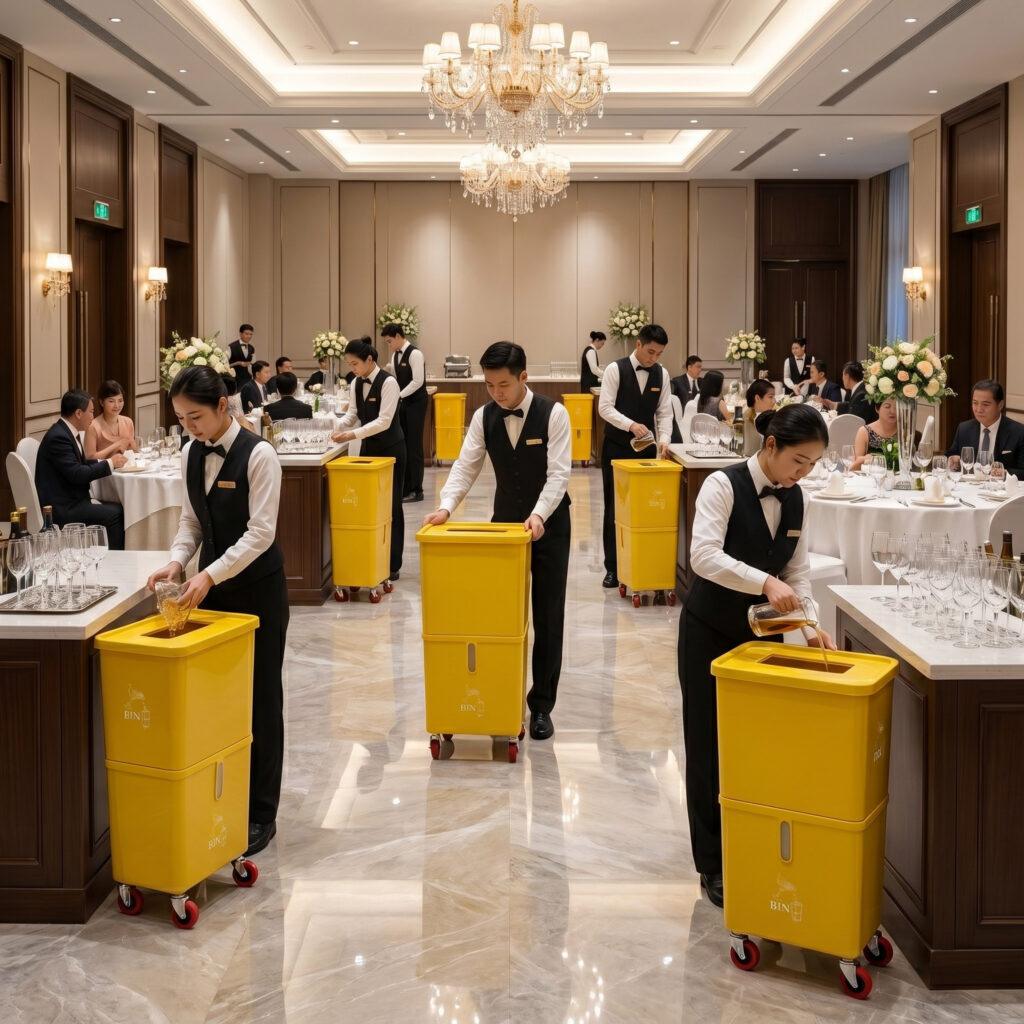
Behind a bar that’s usually the service end, where glassware lands. In a restaurant it’s the dish drop. On a banquet floor it’s near the door servers actually use, not the one guests use. At a concessions counter it’s the end where trays get cleared.
The places it does the most work are the ones with no plumbing at all. Mobile and pop up bars. Catering setups. Food trucks. Festivals. Conference floors between sessions. Poolside service. Stadium and arena concourses. School and university cafeterias. Offices, breakrooms, churches and community halls.
In a public space it can also work as a station guests use themselves. That’s part of why it comes in Black, Blue, Red, Green and Yellow. Back of house you often want it to disappear. In a concourse you want the opposite.
What it is not
It isn’t a bin for general waste. Putting dry rubbish in it wastes the separation and gives you a container to clean for no reason.
It also isn’t a replacement for a sink where you have one within reach. If your bar was built with a dump sink at the well, you’re already fine. The gap it fills is distance, and the rooms where that distance is unavoidable.
Common questions
What is a beverage bin?
A two compartment station for beverage waste. Solids stay on top, liquid drains to a lower reservoir, and the reservoir empties in place through a drain plug.
How is it different from a bus tub?
A bus tub keeps everything together and has to be carried and lifted to be emptied. A beverage waste station separates as it collects and empties through a plug without being lifted.
What’s it made of?
Heavy duty industrial grade HDPE, chosen for impact resistance, leak resistance and a smooth finish that cleans up without holding onto anything.
How do you clean it?
Open the drain plug, rinse both compartments, and lift the lid right off if you need to get at it properly.
What comes in the box?
The bottom compartment, the top compartment, the lid, the caster wheels, compression tape and an assembly manual. Assembly is inserting the top into the bottom, pressing the casters in with the tape, and putting the lid on.
What colours does it come in?
Black, Blue, Red, Green and Yellow.
You can see all five at beveragebins.com, and volume orders start at the wholesale page.
Guides for your setting
Where a station belongs, environment by environment.